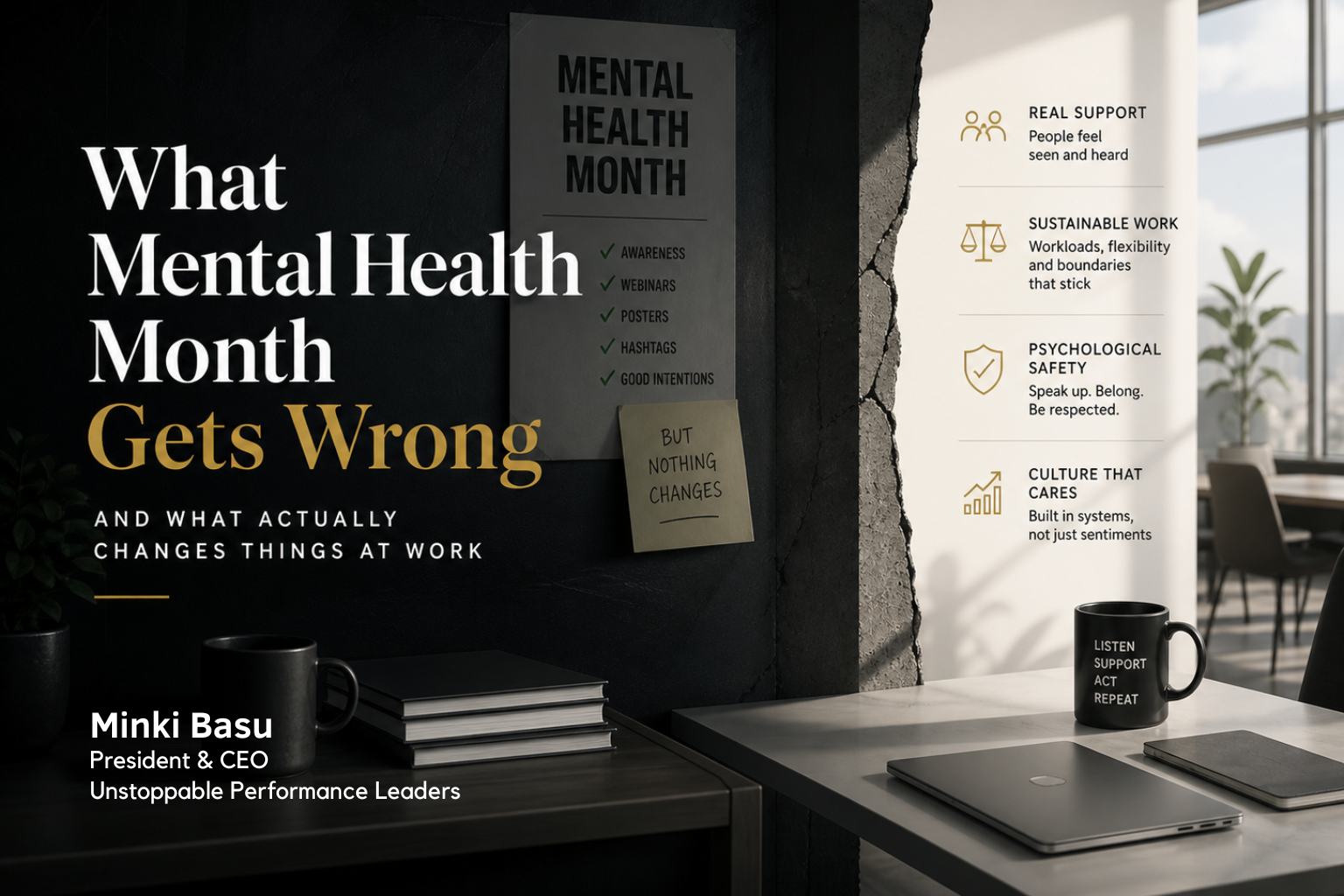
What Mental Health Month Gets Wrong
And What Actually Changes Things at Work
Every May, organizations mark Mental Health Awareness Month. Campaigns launch. Resources are shared. Leaders remind teams that support is available.
And then, in most cases, the workplace goes back to doing exactly what it was doing before.
Awareness is not intervention. And most organizations are intervening at the wrong level.
The individual is not the problem
The dominant model still treats psychological distress as something that happens to individuals. Something to be managed through benefits, apps, or time away.
Individual support matters. But when the environment does not change, the cause remains active.
When the environment stays the same, recovery becomes temporary by design.
The workplace is never neutral. It is always doing something to the people inside it.
What the research actually shows
The factors that determine psychological health at work are organizational. Psychological safety. Respect. Workload. Clarity.
None of these are individual problems. All of them are system conditions.
The research points to organizational conditions, not individual weakness.
The missing conversation
Conflict and fairness sit at the center of workplace mental health, yet they are rarely addressed directly.
Unresolved conflict erodes trust. It increases complaints. It creates the conditions where harm escalates.
Most organizations do not lack awareness. They lack the capability to act when it matters.
What actually changes things
Leaders build capability before programs launch
Conflict is addressed early, not avoided
Fairness is designed, not assumed
Psychological safety is practiced in real interactions, not just announced in a policy. The leader in the room is the intervention.
The leader in the room is the intervention.
A starting point this May
This month, we are offering a focused session on the relationship between conflict management and psychological safety.
Understand why safety and conflict cannot be separated, evaluate certification pathways for your team, and identify your organization’s next step.
- ✓
Give your leadership team a grounded, practical understanding of why psychological safety and conflict management are inseparable
- ✓
Give your HR, People and Culture, and labour relations practitioners a clear picture of whether the WFA or WRP certifications are the right investment
- ✓
Give your organization an honest starting point for deciding whether the full Workplace Fairness and Conflict Management Leadership Program is the right next step
Available as a standalone professional development session. To review the full program outline, use this link: Download the full program outline. To book a call, use Calendly. Or email minki@theunstoppablegroup.com.
Sixty minutes. One conversation. Significant clarity.
The work is already happening. The question is whether you are leading it.
If you want to explore what this session could look like for your organization, or review the full outline first, both are available above.
Book a CallMinki Basu
President and CEO, Unstoppable Performance Leaders
minki@theunstoppablegroup.com | unstoppableperformanceleaders.com
100% Woman-Owned | WBE Canada Certified | IWSCC Certified
More from Perspectives
Thinking on equity, leadership, and the workplace from the field.