The Myth of the Neutral Workplace
Why leadership is the intervention, not the policy
There is a belief that runs quietly through most organizations, that the workplace, by default, is a neutral space. That unless something goes visibly wrong, people are probably fine.
We see this everywhere we work. And we see what it costs.
It costs the manager holding her team together through a restructuring while silently burning out. It costs the high performer who shows up fully in every meeting and quietly disengages everywhere else. It costs the leader who believes his organization is healthy because no one is complaining, not realizing that silence is often the most expensive symptom of all.
The workplace is never neutral. It is always doing something to the people inside it.
The only question is whether anyone is paying attention.
What organizations get wrong
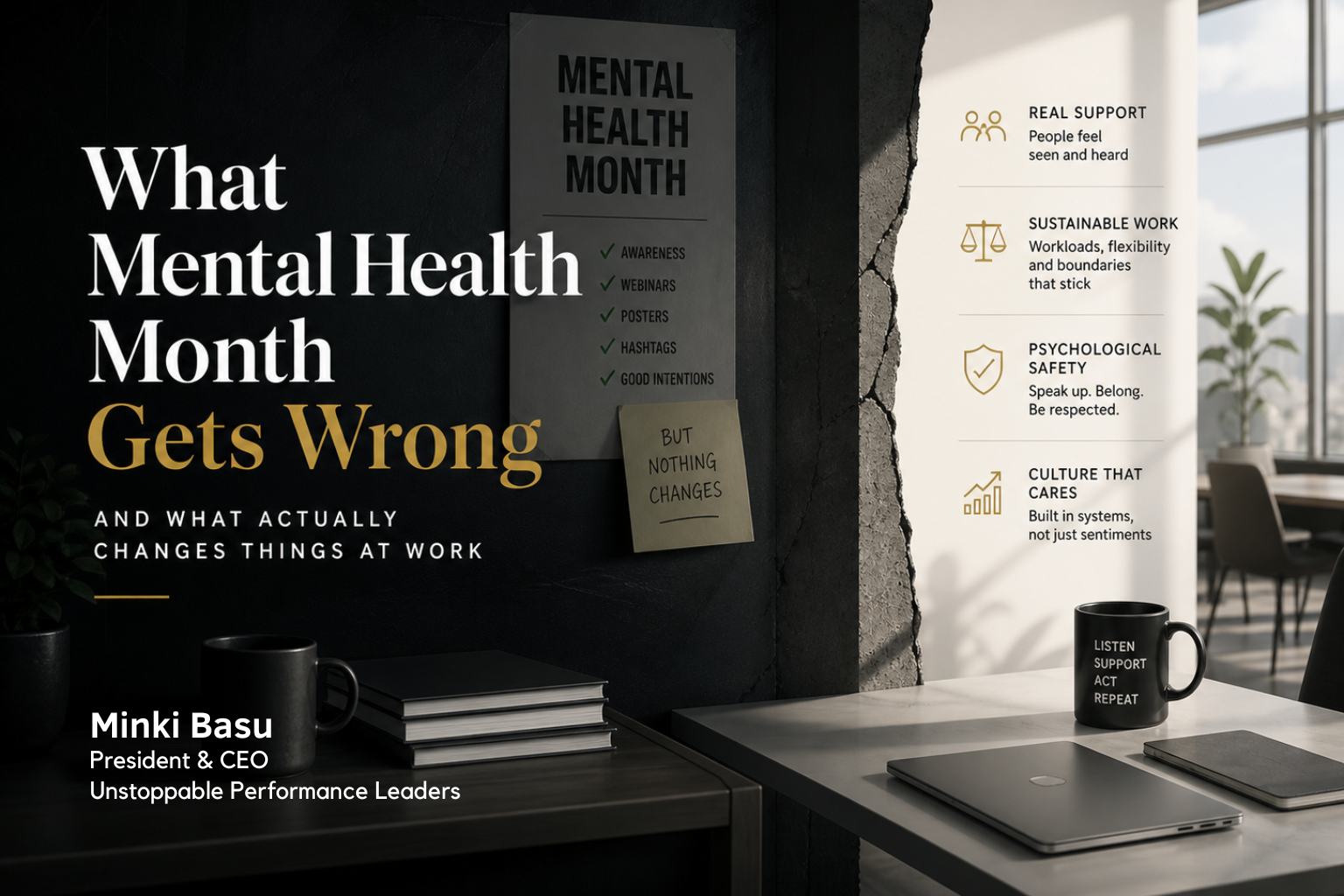
Most organizations respond to psychological health the same way. A workshop after a difficult quarter. An EAP reminder in a newsletter. A mental health awareness campaign with a logo and a tagline.
These are not strategies. They are responses to the optics of having no strategy.
People inside organizations can feel when a program exists to check a box versus when an organization is genuinely invested in how its people experience their work.
That distinction, felt, not announced, is what determines whether your efforts actually land.
What the research tells us, and what leaders often miss
The National Standard for Psychological Health and Safety in the Workplace identifies 13 psychosocial factors that shape whether a workplace supports or undermines mental health. Psychological safety. Workload management. Clear leadership. Civility and respect. None of them are exotic. All of them are within an organization’s control.
What the research also tells us, consistently, is that programs alone do not move these factors. Leaders do.
The organizations that make measurable progress on psychological health are not the ones with the most polished initiatives.
They are the ones where leaders understand that their behavior is the actual intervention. Not the policy document. Not the training deck. The leader, in the room, on the call, in the moment of a difficult decision.
When a manager creates space for someone to say “I’m not okay” without that admission becoming a liability, they are practicing psychological safety in the most literal sense. When a senior leader names uncertainty instead of performing confidence, they reduce the threat response in every person watching. When a team is given genuine clarity on what is expected of them, real clarity, not the kind buried in a job description, they can do their best work.
These are not soft leadership qualities. They are structural conditions.
And they can be built, measured, and sustained with the right support.
The legal context is shifting, and quickly
For federally regulated organizations, this conversation has moved well beyond values. Bill C-65 made harassment and violence prevention a legal obligation. For provincially regulated employers, occupational health and safety legislation across North America is increasingly being interpreted to include psychological harm alongside physical harm.
The organizations getting ahead of this now are not just avoiding liability. They are building cultures that retain people, attract talent that has options, and outperform on every metric that matters over a three to five year horizon.
The ones waiting for a triggering event will spend far more, in legal exposure, turnover costs, and recovery time, than the investment required to build something healthy from the inside.
From awareness to action, what it actually requires
They start with an honest assessment, not a survey designed to produce comfortable numbers, but a real look at what their psychosocial environment is doing to people.
They build leader capability before they launch programs, because a program delivered into a psychologically unsafe team does more harm than good.
They measure what matters, not just participation rates and satisfaction scores, but leading indicators such as psychological safety, clarity of expectations, and quality of manager relationships.
They treat this as ongoing work, not a project with a completion date. Because the workplace is never static. Neither are its people.
The highest performing organizations do not wait for a crisis to discover what their culture is doing. They design leadership conditions on purpose, then reinforce them with evidence, feedback, and accountability.
The question worth asking
If you asked the people in your organization, anonymously, honestly, whether they feel safe bringing their full attention and effort to their work, what would they say?
And if the answer gives you pause, that pause is the most important place to start.
About Unstoppable Performance Leaders
Unstoppable Performance Leaders delivers psychological health and safety programming, leadership development, and EDIB advisory to organizations across North America. Our ecosystem of independent subject matter experts brings specialized, evidence-based expertise to every engagement.
Minki Basu
President & CEO, The Unstoppable Group Inc. (UPL)
minki@theunstoppablegroup.com | unstoppableperformanceleaders.com
100% Woman-Owned | WBE Canada Certified | IWSCC Certified
Ready to build a workplace people can trust?
Let’s start with an honest assessment of the conditions shaping your workplace. Every UPL engagement begins with a 90 minute strategic consultation.
Build the ConditionsMore from Perspectives
Thinking on equity, leadership, and the workplace, from the field.